

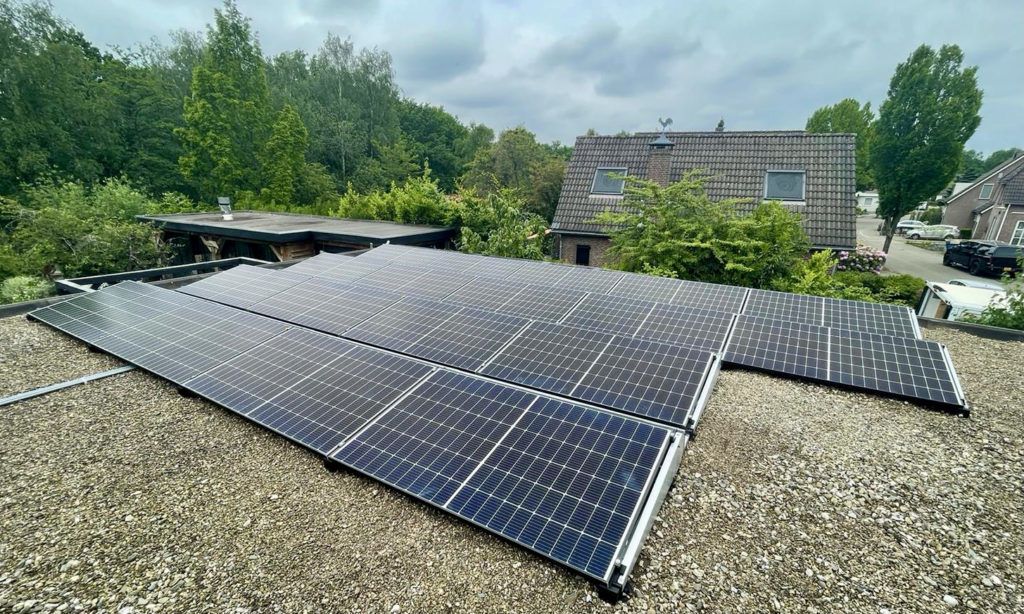
The Choice: Series or Parallel Solar Panels on My Roof
Solar panel systems can be installed in three ways: in series, in parallel, or using micro-inverters. The option you choose greatly affects how your solar energy system functions. OptimaSolar explains everything about series and parallel setups, helping you make the right decision for your roof.
Solar Panels in Series
The first method is connecting solar panels in series, or in other words, a string system. Traditionally, this has been the most commonly used setup. It’s a series of solar panels connected one by one, forming a large circuit. The energy generated is passed through the circuit to a single inverter.

Series-Connected Solar Panels at OptimaSolar
OptimaSolar often uses inverters from Solis. The current received by the inverter is converted from direct current to alternating current after which it goes to the fuse box. As electricity always travels the shortest distance, the appliances in the home are the first to be supplied with self-generated power. The remaining power that is not directly used will be sent to the grid. The total output of the system can be monitored via an app on a phone or tablet, for example.

Recent completed projects


The Advantages and Disadvantages of Series-Connected Solar Panels
A major advantage of series-connected solar panels is their cost-effectiveness. With fewer components in the system, there is less resistance, which helps reduce energy losses. A string system is ideal for roofs that don’t have shading, as the weakest panel in the series dictates the performance of the entire system. However, if one panel fails or there is an issue with any part of the system, the output of the entire array can be significantly impacted, potentially resulting in little or no energy production.

Shading and Series-Connected Solar Panels
If your roof is shaded for part of the day, a series-connected system is not recommended. However, if only a few panels are affected by shading, OptimaSolar offers a smart solution: we equip those panels with Tigo optimizers. These optimizers are placed behind the shaded panels, ensuring that the rest of the system is not impacted. With this solution, you don’t need to invest in a more expensive parallel system, where each panel would require its own optimizer.
Solar Panels Connected in Parallel
The second way is to connect solar panels in parallel. In this process, each solar panel is fitted with an optimizer. Among other things, this ensures that the solar panels do not depend on each other and the voltage remains optimal. The great advantage of this parallel-connected system is that factors such as shade, pollution or defects on one or more solar panels do not affect the rest of the system. OptimaSolar uses SolarEdge inverters and optimizers for this purpose.

Safety for Solar Panels Connected in Parallel
A typical solar panel operates at around 40 volts. However, with SolarEdge’s SafeDC system, this voltage is reduced to just 1 volt in the event of a shutdown or malfunction. This enhances safety significantly. Additionally, the parallel-connected system provides the highest efficiency, and the output per panel can be monitored via a dedicated app on your phone.

Solar Panels Without an Inverter: Microinverters
Finally, the third way. Instead of a central inverter, there is also the possibility of placing so-called micro-inverters under each panel. Should a micro-inverter or a solar panel break down, this does not cause any problems for the energy yield. In fact, the other panels will continue to provide maximum output. With a so-called Envoy (Enphase Energy) or an ECU-R (APsystems), a small box in the fuse box, the system can be read.
Moreover, it is always possible to expand the system later with more solar panels and thus with more micro-inverters. In order for your solar panels to function according to this system, you will be a bit more expensive than if you opt for series-connected solar panels. Besides the technical advantages, a system also has a warranty period of 20 or 25 years.
If you have any questions or need advice, you can reach us at 0800 – 2468 000. Feel free to make an appointment for a no-obligation consultation.
No-obligation consultation
Customer reviews

We are very happy with our solar installation from OptimaSolar. Wim took the time to meet us at our house to give us advice and estimations. The work was carried out very neat and tidy and Wim himself... [ lees meer ]
- Slabbert Family

Great job! Thank you!
- Daniel Stanciu

Got quotes from 3 other solar panel vendors, found optima solar the best for the price i paid. Panels were installed ontime with the perfection.... After sales support is also excellet. Thankyou.
- S B
Want to explore our recent cases?


Schedule a free consultation
