

Home battery
While solar panels have already been subject to a 0% VAT rate for several years, a home battery is still taxed at 21% VAT. However, in some cases, this VAT can be reclaimed through the Dutch…
A home battery without solar panels allows you to store and charge electricity when rates are most favourable. Even without generating your own electricity with solar panels, you can save on energy costs and even earn money with a smart battery combined with an Energy Management System (EMS). How? We’ll explain it all.
With a home battery without solar panels, you can take advantage of dynamic energy rates (EPEX prices). To benefit from this, you need a dynamic energy contract. Only with such a contract can electricity prices vary every 15 minutes and gas prices be set daily. Prices are based on supply and demand on the energy market and are determined one day in advance.
When the battery operates based on dynamic prices, it automatically charges when electricity prices are low and discharges to the grid when prices are high. This allows you to earn money. It is also possible to charge only at the lowest prices and use that energy in your home later.
In most cases, home batteries trade at EPEX prices, with the battery automatically charging when prices are low or negative and discharging during peak times. This allows you to benefit from price fluctuations on the energy market. In addition, the battery can also be used on the imbalance market, where it helps keep the grid in balance by automatically charging or discharging when required by the energy supplier. You will receive compensation for this.
Even without solar panels, a home battery can be used as a backup during a power outage. To do this, the battery must have a backup power function and be correctly connected to the meter box, with part of its capacity reserved for emergency power. This ensures that important appliances such as lighting and internet continue to work during a power failure. Please note that without solar panels, the battery will not recharge during an outage and may run out over time.
Frank Energie and NextEnergy are examples of suppliers where a dynamic energy contract allows you to trade at EPEX prices and participate in the imbalance market. In addition, technology partners such as Bliq enable smart battery control. Finally, Currentt’s local energy management system makes it possible to control a “dumb” battery in a smart way.
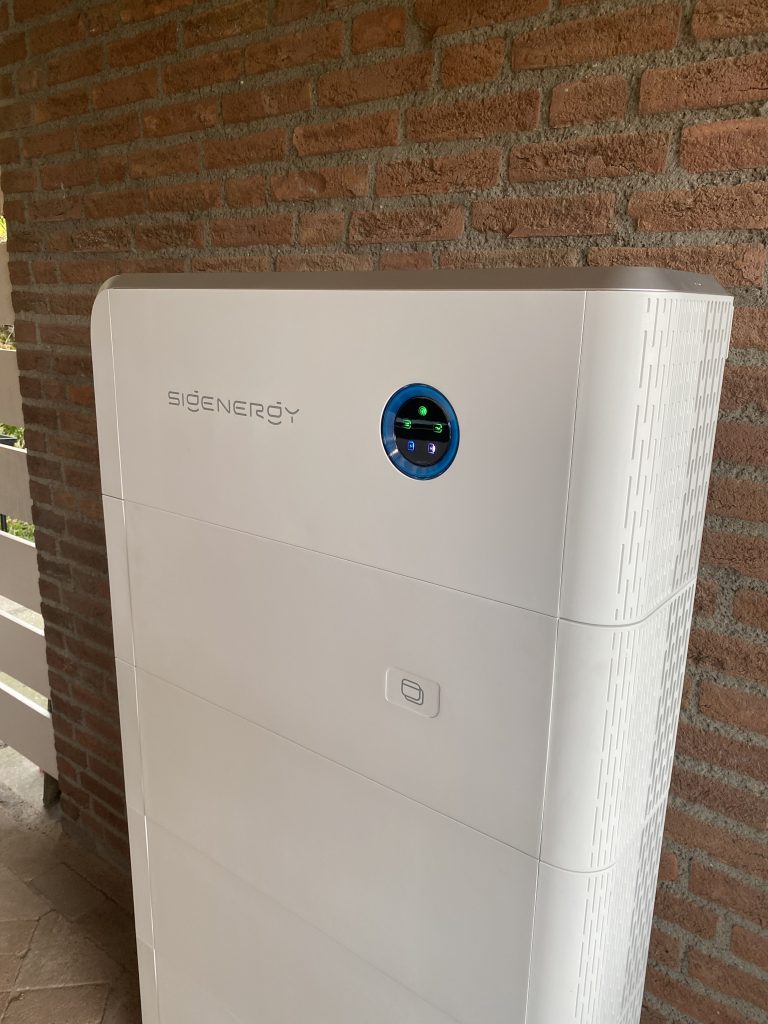
There are two types of home batteries. Plug & play batteries can simply be plugged into a power outlet and are suitable for basic use. These batteries often have a low charge and discharge capacity and are therefore not suitable for real trading on the energy market. Grid-connected AC batteries are connected to the meter box on their own circuit and are ideal for households without solar panels that want to use cheap electricity in larger volumes.
An AC-coupled battery is connected to its own circuit in the meter box and consists of a battery controller or inverter, battery modules, a smart energy meter, and in some cases an Energy Management System (EMS). The battery then charges and discharges automatically based on tariffs or control signals.
The price depends on capacity, power, and smart features. On average, a small battery (±5 kWh) costs €3,000–€6,000, and a larger battery (±10 kWh) costs €7,000–€10,000. This allows you to choose a solution that perfectly suits your situation and usage goals.
Are you interested in a home battery for your household? Contact us for a free quote.
While solar panels have already been subject to a 0% VAT rate for several years, a home battery is still taxed at 21% VAT. However, in some cases, this VAT can be reclaimed through the Dutch…
The electricity grid in the Netherlands is increasingly under pressure. In some regions, the grid is even so congested that new connections are no longer possible. As a result, Enexis is asking households to temporarily curtail…