

Inverters
Want to get the most out of your solar panels? Then it’s important that your APsystems monitoring is working properly. This allows you to keep track of your solar energy production and quickly detect any issues….

Micro-inverters: Also referred to as solar panels without inverters. But solar panels without an inverter? That doesn’t exist! The inverter is an essential part of a solar energy system. The direct current (DC) generated by solar panels must be converted into alternating current (AC) so you can use the energy in your home. If you’d prefer not to have a large inverter in your home, micro-inverters might be the perfect solution for you! Here’s how it works:
An inverter is the core component of your solar panels, ensuring optimal efficiency and guaranteeing the safety of your entire system. There are several benefits to opting for micro-inverters. First, you won’t have a central inverter in your home, which saves space (no need for extra room in the attic or garage) and reduces noise. Additionally, a system with micro-inverters works in parallel. If one micro-inverter fails, the other panels continue to produce energy, even if one panel is shaded.
Let’s start with the basics. Solar panels generate DC, but the electricity in your home is AC. This conversion is what an inverter does! You have central inverters, which are installed inside the home, or you can opt for micro-inverters. These are small devices attached to each panel, allowing for a parallel system where each panel functions independently and can be monitored individually. With micro-inverters, you can track the performance of each solar panel through an app.
The solar panels are installed on your roof, with a micro-inverter beneath each one. OptimaSolar uses micro-inverters from Enphase Energy, and as of July 1, we’ve also added APsystems to our range. These micro-inverters are connected through Enphase Q-cables or APsystems bus cables. The Q-cable ends in a junction box, which links to an AC cable, ultimately connecting to a residual current circuit breaker in your meter cupboard. Once connected, the system starts supplying power – let the sun shine!
Micro-inverters are ideal if your roof is obstructed by trees, chimneys, or dormer windows. Micro-inverters help maintain optimal energy production, which means you’ll recover your investment faster. The fire risk is also lower with this system because it operates entirely on AC, avoiding high voltages on your roof. Micro-inverters also act as a safety mechanism – if voltage or frequency levels become too high, they automatically shut down. They meet the strictest industry standards.
Expanding a system with micro-inverters is simple. Traditional inverters have a maximum capacity for the number of panels they can handle. If you expand beyond that capacity, you might need to replace the inverter. With micro-inverters, this limitation doesn’t exist – you can easily add more panels.
As energy consumption increases – whether due to a growing family, the purchase of an electric car, or the installation of a heat pump – it’s essential to think about future expansion. With the end of the net metering scheme in 2027, it’s beneficial that Enphase and APsystems systems are already compatible with home batteries. These batteries, made with lithium iron phosphate chemistry, have a long lifespan and are modular, meaning they can be expanded in the future.
The main disadvantage of micro-inverters is their cost. However, APsystems’ system is more affordable compared to Enphase. While a solar system with micro-inverters is more expensive than one with a central inverter, micro-inverters provide several long-term benefits. The downside is that if a micro-inverter malfunctions, it can be more challenging to replace compared to central inverters. However, this is also the case with systems that use SolarEdge optimizers.
Installing solar panels with micro-inverters also benefits from a longer warranty. Micro-inverters typically come with warranties of 20 to 25 years – the same lifespan as the solar panels themselves. In contrast, traditional inverters last around 8 to 12 years, meaning you’ll need to replace them once before your solar panels reach their full lifespan.
Interested in installing Enphase or APsystems micro-inverters on your roof? Feel free to schedule an appointment for a no-obligation quote!
Want to get the most out of your solar panels? Then it’s important that your APsystems monitoring is working properly. This allows you to keep track of your solar energy production and quickly detect any issues….
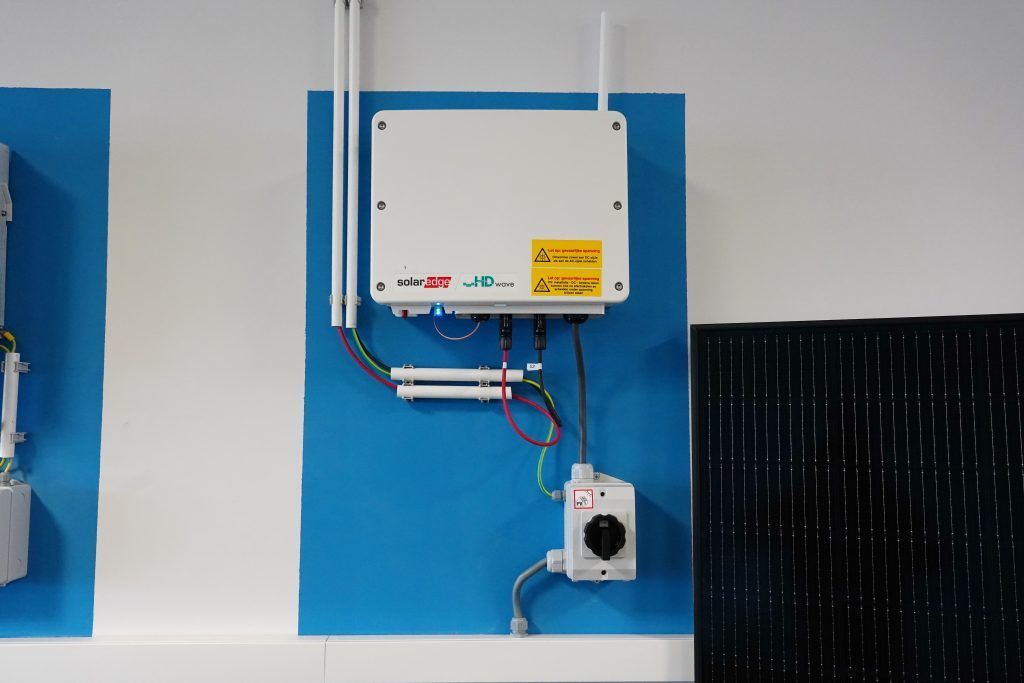
Want to get the most out of your solar panels? Then it is important that your SolarEdge monitoring is working properly. This allows you to see exactly how much electricity your system is producing and quickly…