

Inverters
Want to get the most out of your solar panels? Then it’s important that your APsystems monitoring is working properly. This allows you to keep track of your solar energy production and quickly detect any issues….

The inverter is the true engine of your solar panel system—an essential component in any solar energy installation. When installing solar panels, you can choose between a 1-phase or 3-phase inverter. But what determines the right option for you?
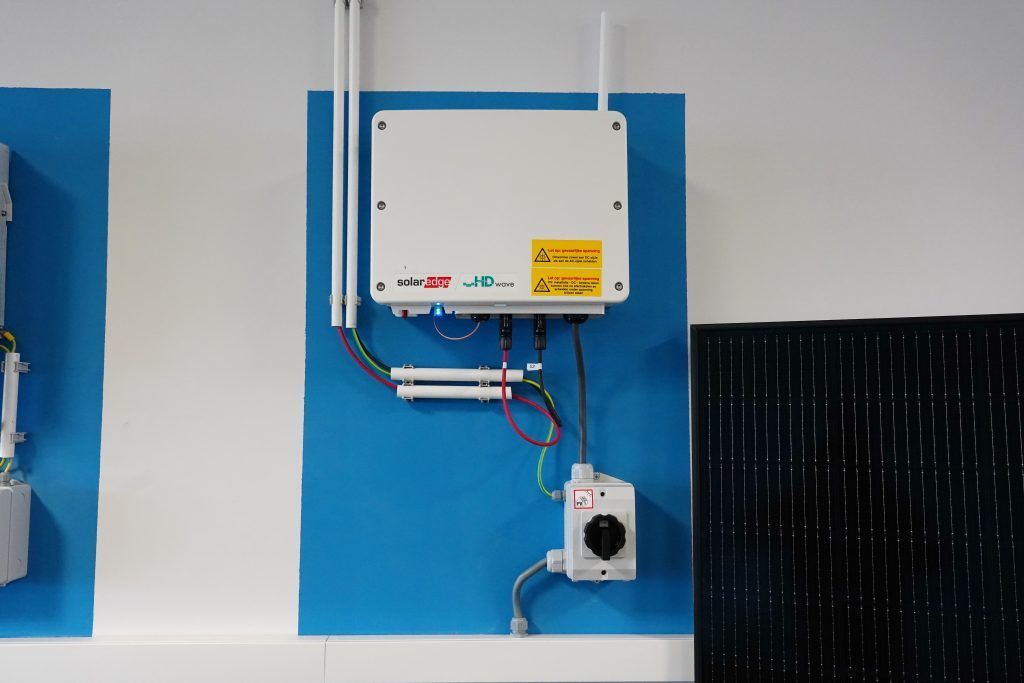
Let’s start with the basics. Solar panels generate direct current (DC), while your household uses alternating current (AC). The inverter’s job is to convert DC into usable AC electricity. There are central inverters that are installed inside the home, and micro-inverters, which are small devices mounted under each panel.
The inverter connects to your solar panels via DC cables. It converts the incoming DC into AC, which then travels through an AC cable to your electrical panel. From there, the power is either used within your home or fed back into the electricity grid.
Every home in the Netherlands has a main electrical connection, which largely determines the type of solar energy system that can be installed. The most common 1-phase connections are 1 x 25A or 1 x 35A, delivering current via a single wire. A 3-phase connection (e.g., 3 x 25A) distributes current over three wires and is common in modern new-build homes.
If your home has a 1-phase main connection, you’re limited to a 1-phase inverter. A 3-phase inverter cannot be installed with a 1-phase connection. Solis string inverters start at 1 kW, and SolarEdge parallel inverters start at 2.2 kW.
Homes with a 3-phase connection offer more flexibility. You can choose either a 1-phase or 3-phase inverter. Solis and SolarEdge 3-phase inverters typically start at 3 kW. When choosing, it’s wise to consider future energy needs—think of appliances like heat pumps, EV chargers, or induction cooktops.
With a 1-phase inverter, we typically install up to 14 panels. These inverters are cheaper than 3-phase ones, which means a faster return on investment. They also require less start-up voltage, meaning they begin working earlier in the day and shut off later in the evening. 1-phase inverters are also usually more compact.
Planning to install high-power appliances? You may need to upgrade your main connection—for example, from 1 x 35A to 3 x 25A. This is especially relevant for induction hobs over 7.6 kW. You can apply for an upgrade via the Enexis grid operator website. Due to possible wait times, it’s best to submit your request early.
Important: One condition from the grid operator is that your electrical panel must meet current standards and be 3-phase ready. Our certified electricians can carry out these upgrades. Some are authorized to seal the meter cabinet themselves.
Would you like to see 1-phase and 3-phase inverters up close? Feel free to schedule a no-obligation consultation with us!
Want to get the most out of your solar panels? Then it’s important that your APsystems monitoring is working properly. This allows you to keep track of your solar energy production and quickly detect any issues….
Want to get the most out of your solar panels? Then it is important that your SolarEdge monitoring is working properly. This allows you to see exactly how much electricity your system is producing and quickly…